

- Key Insight: See why rising annual home price indices are masking weak underlying consumer demand.
- Forward Look: Get ready for the upcoming federal determination of conforming loan limits for 2027.
Overview bullets generated by AI with editorial review.
Processing Content
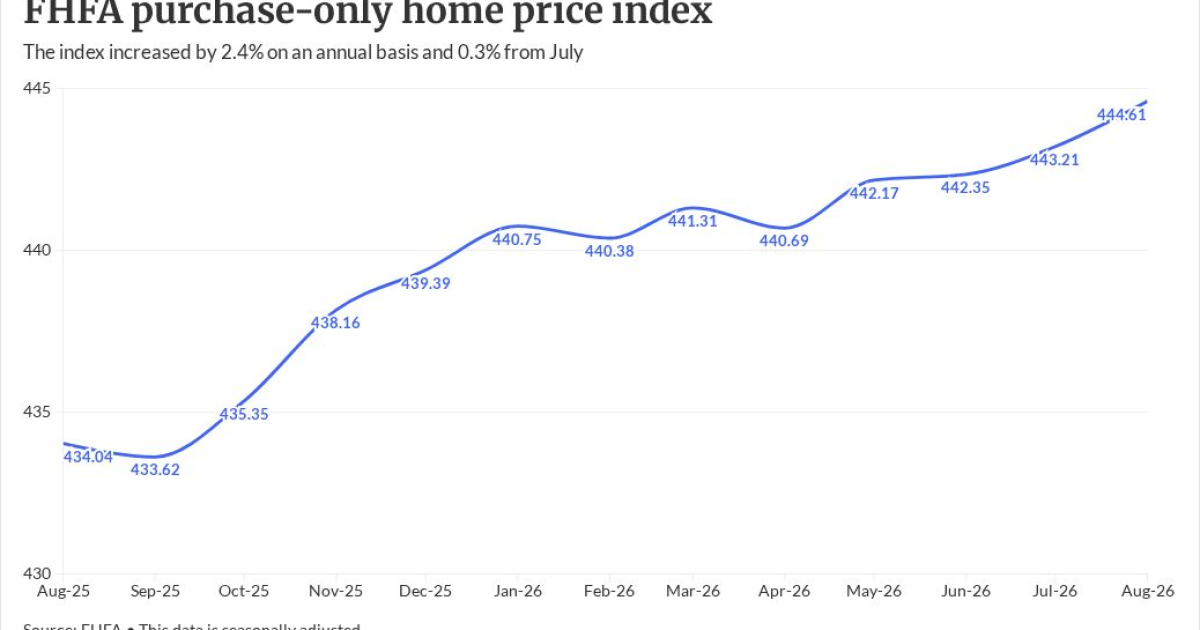
Home prices grew on an annual basis by 2.4% in August, the Federal Housing Finance Agency announced, in the next-to-last release before the one used to help set the conforming loan limits for 2027.
On a month-to-month basis, the FHFA HPI changed by 0.3% higher, compared with a revised 0.2% increase in July.
While the S&P Cotality Case-Shiller Home Price Index for the national data set grew by 2.1% versus August 2025, it declined 0.2% from July, not seasonally adjusted.
“U.S. home prices declined in real terms for the 15th consecutive month in August 2026, though the gap narrowed as nominal home price growth strengthened,” said Rebecca Kaufman, associate director of commodities at S&P Dow Jones Indices, in a press release.
Current home values along with mortgage rates which have climbed back over 7% has tied up the home sales market.
Prices have been mostly flat since 2022 on an inflation-adjusted basis, said Thomas Malone, Cotality’s principal economist, in a separate press release. Home turnover remains at levels seen during the Great Recession.
He blames seller lock-in, which gives current owners little incentive to move unless they get a great offer.
“It also reflects weak underlying demand,” Malone said. “After more than three years of slow sales, today’s activity may be the new normal rather than a temporary dip.”
Seasonality continued to affect the monthly results, because as adjusted, the national index rose 0.3%.
“The divergence suggests that the typical post-summer slowdown is obscuring some underlying strength in home prices,” Kaufman said.
The Case-Shiller data shows demand remains in the housing market, even with the affordability challenges, said Matt Vernon, head of consumer lending at Bank of America.
“It’s important to remember that national trends don’t always reflect what’s happening in individual market,” Vernon said. “Whether someone is buying, selling or staying put, understanding local conditions can provide a clearer picture of the opportunities and challenges ahead.”
The decision to buy a home is not just based on the listing price, instead focusing on what works for their budget rather than wait for perfect market conditions.
“Lenders need to recognize that buyers are finding different ways to navigate affordability challenges and that a traditional path to homeownership may not work for everyone,” Vernon explained. “Some are considering buying with friends or family, while others are exploring assistance programs to help with upfront costs.”
This is where the mortgage loan officer can help, by educating potential buyers on down payment and closing cost assistance, plus high loan-to-value programs which require less out of pocket.
“Borrowers want transparency, clear communication and confidence that their lender understands their needs,” Vernon said. “They need to know what they can afford, what costs to expect and how different financing options fit into their broader financial picture. Just as importantly, they want a lender who will take the time to answer questions and help them navigate what can be an unfamiliar and complicated process.”
An
So far, five non-bank lenders are already
But on a regional basis, the month-to-month results widely vary, with prices in New England declining by 0.8% and the South Atlantic and Pacific states reporting a 0.1% drop. Prices were unchanged in the Middle Atlantic states.
On the other hand, among the other regions, the East South Central saw values grow between July and August by 2.1%.
In all regions, the FHFA reported price increases, ranging from 0.5% in the Mountain states to 4.4% for those in the East North Central area.
For August, the FHFA purchase-only HPI had a 444.61 value, a high in the data, which is available back until 1991. This compared with 443.21 in July and 434.06 for August 2025.
First American’s own home price index for September, released on Oct. 26, reported 1.2% annual increase and no change from August.
Annual house price growth was at its weakest September pace since 2011, said Mark Fleming, chief economist at First American.
“Homeowners’ ability to remain in their homes and become neither a seller nor a subsequent buyer, rather than
Colin McNamara contributed reporting to this story.